
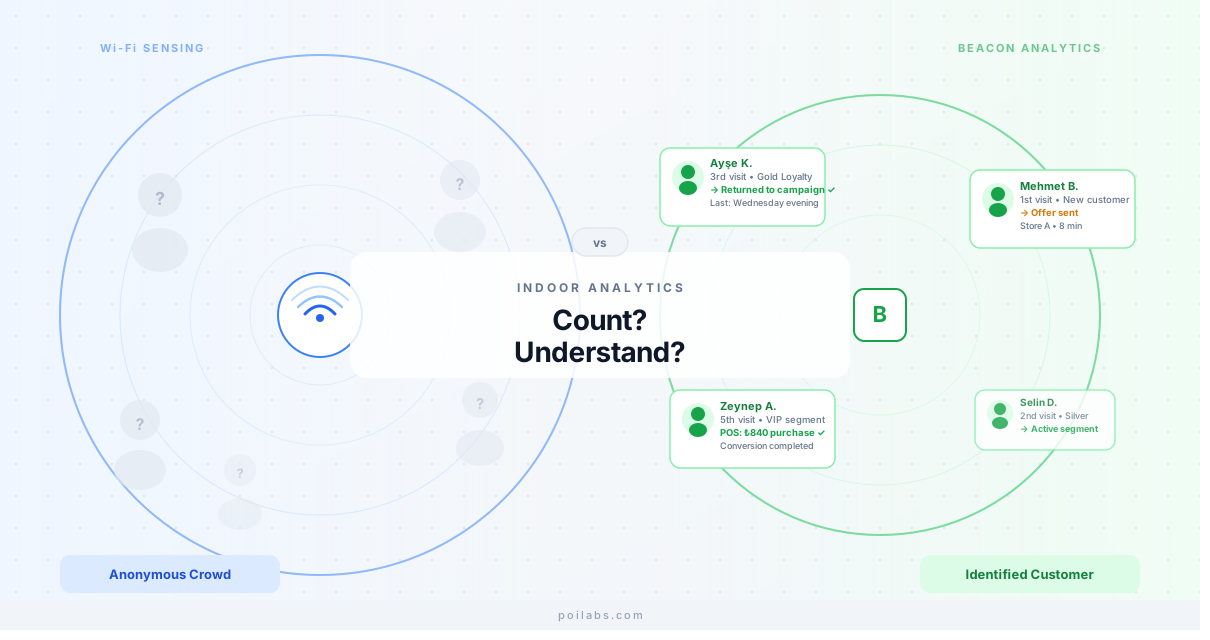
In indoor analytics, there is a big difference between “counting” and “understanding.” In recent weeks, a video entered Turkey’s technology agenda: even if your phone is turned off, you leave your wallet at home, and you do not look at any screen, the moment you enter a venue, Wi-Fi signals can detect you. No camera, no microphone. Your body disrupts radio waves, and an artificial intelligence system infers from that disruption: “There is a person here.” Impressive. And also a little unsettling.
As someone who has worked in indoor positioning for years, my first reaction was not curiosity, but the need to make a correction. Because there is a marketing claim growing around this technology: “We can now do visitor analytics with Wi-Fi; there is no need for an app or beacons — Bluetooth sensors — anymore.” This statement is half true and half misleading. And that misleading half is exactly the part that costs a shopping mall or retail brand money. The issue is this: counting a crowd and understanding a customer are not the same thing.
Wi-Fi sensing is not something to be underestimated. It is quite successful at anonymously measuring the total number of people entering a venue, which corridors are becoming crowded, and how occupancy fluctuates throughout the hour. Moreover, it does this without waiting for people to install an app, by “seeing” everyone. In other words, sensing is a valuable tool for a rough answer to the question: “How many people came, and where did they flow?” But is this really what a retail brand expects from analytics? Ask a store manager or a shopping mall marketing director, “What should good analytics tell you?” The answers are almost never limited to “how many people passed by/came in.” The real questions retail asks are:
-Had this person visited before?
-Is this a first-time visitor or a loyal customer?
-Did they return because of the campaign we sent last month?
-Which stores/sections did they enter and spend time in, and did they eventually make a purchase?
-How does this segment in the loyalty program actually behave inside the store?
-And most importantly: can I use this information to deliver an offer to that person right now?
All of these questions have one thing in common: identity. A customer you know with their consent, whose profile you understand, and whom you can recognize again.
This is exactly where sensing hits a wall — not because of a flaw, but by definition. Sensing is anonymous; it says, “There is a body here,” but it cannot say, “This is Ms. Ayşe, a loyalty card member, and this is her third visit.” And because it cannot say that, it cannot deliver a notification, a discount, or a direction to that person. There is no bridge between what it measures and the ability to take action.
There is also a technical reality that is rarely discussed: classic Wi-Fi-based visitor counting has become seriously unreliable for counting unique individuals because phones now randomize MAC addresses — a standard feature on modern iOS and Android devices. Since the same phone can appear with a different identity in every scan, the question of “how many different people” becomes blurred. In other words, anonymity does not only remove identity; it often removes accurate counting as well.
As someone who has worked in indoor positioning for years, my first reaction was not curiosity, but the need to make a correction. Because there is a marketing claim growing around this technology: “We can now do visitor analytics with Wi-Fi; there is no need for an app or beacons — Bluetooth sensors — anymore.” This statement is half true and half misleading. And that misleading half is exactly the part that costs a shopping mall or retail brand money. The issue is this: counting a crowd and understanding a customer are not the same thing.
Wi-Fi sensing is not something to be underestimated. It is quite successful at anonymously measuring the total number of people entering a venue, which corridors are becoming crowded, and how occupancy fluctuates throughout the hour. Moreover, it does this without waiting for people to install an app, by “seeing” everyone. In other words, sensing is a valuable tool for a rough answer to the question: “How many people came, and where did they flow?” But is this really what a retail brand expects from analytics? Ask a store manager or a shopping mall marketing director, “What should good analytics tell you?” The answers are almost never limited to “how many people passed by/came in.” The real questions retail asks are:
-Had this person visited before?
-Is this a first-time visitor or a loyal customer?
-Did they return because of the campaign we sent last month?
-Which stores/sections did they enter and spend time in, and did they eventually make a purchase?
-How does this segment in the loyalty program actually behave inside the store?
-And most importantly: can I use this information to deliver an offer to that person right now?
All of these questions have one thing in common: identity. A customer you know with their consent, whose profile you understand, and whom you can recognize again.
This is exactly where sensing hits a wall — not because of a flaw, but by definition. Sensing is anonymous; it says, “There is a body here,” but it cannot say, “This is Ms. Ayşe, a loyalty card member, and this is her third visit.” And because it cannot say that, it cannot deliver a notification, a discount, or a direction to that person. There is no bridge between what it measures and the ability to take action.
There is also a technical reality that is rarely discussed: classic Wi-Fi-based visitor counting has become seriously unreliable for counting unique individuals because phones now randomize MAC addresses — a standard feature on modern iOS and Android devices. Since the same phone can appear with a different identity in every scan, the question of “how many different people” becomes blurred. In other words, anonymity does not only remove identity; it often removes accurate counting as well.
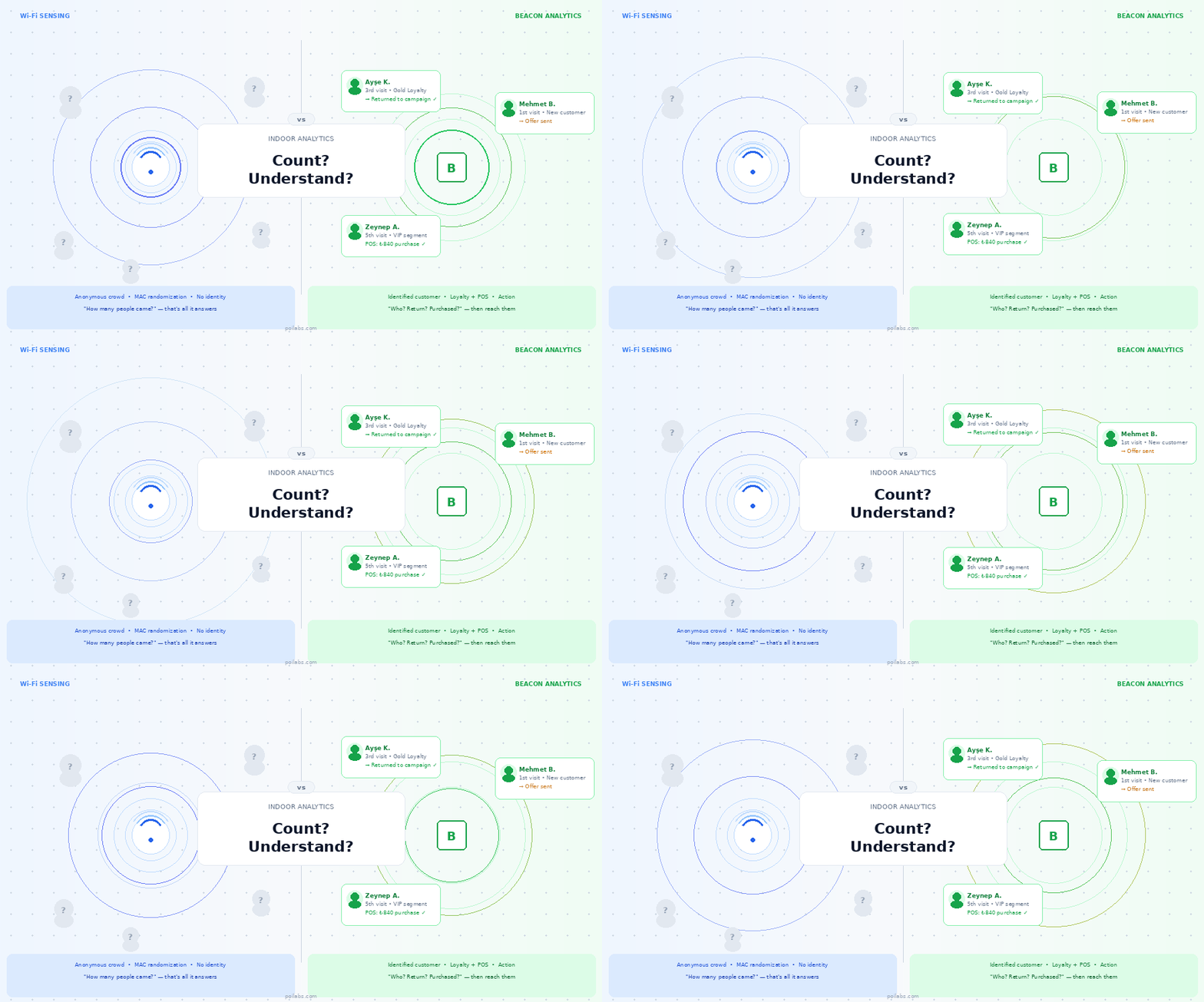
PoiLabs’ beacon- and app-based approach starts from a completely different point: a customer whose consent has been obtained and whose identity is known. When this foundation changes, the analytics change as well:
Customer-level journey: Not “a body entered,” but “this customer went from the entrance to Store X, stayed for 6 minutes, and converted at the checkout.” Not an anonymous heat map, but identifiable behavior.
Loyalty and POS integration: You can combine in-store behavior with the loyalty program and sales data. This gives the real answer to the question: “What does this segment actually do in the physical store?”
Deterministic location: Not “approximately this area,” but “exactly this store, this POI.” Not vague, but precise.
Cross-platform consistency: Because it is app- and SDK-based, it works the same way on both iOS and Android.
Measuring and taking action within the same system: The same infrastructure both measures behavior and delivers a notification, offer, or direction to that person. There is a bridge between measurement and action.
Customer-level journey: Not “a body entered,” but “this customer went from the entrance to Store X, stayed for 6 minutes, and converted at the checkout.” Not an anonymous heat map, but identifiable behavior.
Loyalty and POS integration: You can combine in-store behavior with the loyalty program and sales data. This gives the real answer to the question: “What does this segment actually do in the physical store?”
Deterministic location: Not “approximately this area,” but “exactly this store, this POI.” Not vague, but precise.
Cross-platform consistency: Because it is app- and SDK-based, it works the same way on both iOS and Android.
Measuring and taking action within the same system: The same infrastructure both measures behavior and delivers a notification, offer, or direction to that person. There is a bridge between measurement and action.
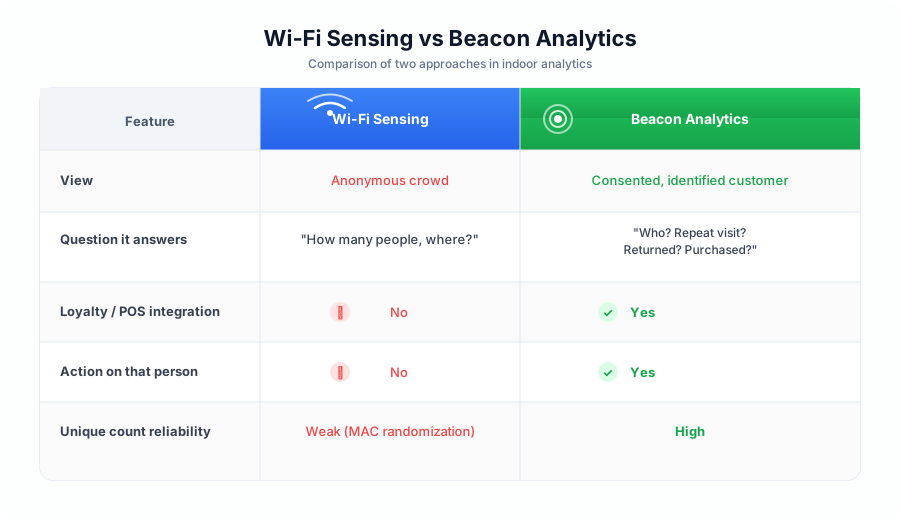
It is possible to draw an easy but wrong conclusion from this: “Then sensing is useless.” No, that is not the case.
The two technologies answer two different questions.
The strongest setup is to combine the two: sensing for anonymous breadth — count everyone who does not have the app and has not been detected by a beacon. Beacon for depth — understand the known customer, track their behavior, and take action. Get the total number of people from sensing; get the story, behavior, and conversion within that traffic from beacon. A privacy-respecting, properly designed analytics platform becomes stronger by blending both.
This is exactly the perspective we take at PoiLabs.
“Wi-Fi or beacon?” is the wrong question. The right question is:
Are you counting — or are you understanding?
The one who does both correctly wins.
The two technologies answer two different questions.
The strongest setup is to combine the two: sensing for anonymous breadth — count everyone who does not have the app and has not been detected by a beacon. Beacon for depth — understand the known customer, track their behavior, and take action. Get the total number of people from sensing; get the story, behavior, and conversion within that traffic from beacon. A privacy-respecting, properly designed analytics platform becomes stronger by blending both.
This is exactly the perspective we take at PoiLabs.
“Wi-Fi or beacon?” is the wrong question. The right question is:
Are you counting — or are you understanding?
The one who does both correctly wins.
Wi-Fi Can Count People — But Does It Know Your Customer?